In this section we introduce the Baire category theorem. Ultimately the Baire category theorem is used to answer the question when is a subset in a topological space small, which turns out to be a fundamental tools in the study of linear bounded operators. This section and in particular the qualiatative and quantitative discussion is inspired by T. Tao Tao (2009).
Small sets in a Measure Space
In a measure theory setting i.e. the “small” sets are the nullsets i.e. such that or subsets of nullsets. Countable additivity implies that countable unions of nullsets are of measure zero. This gives us results like this:
Lemma 1
Let be an at most countable sequence of measurable sets of a measure . If then at least one of the has positive measure.
The next proposition bridges between measure theory and topology. To motivate it, recall that the Lebesgue differentiation theorem tells us that for almost every point , the density of at ,
equals one. Such points are called density points of — points where fills up nearly all of every sufficiently small ball. One can think of density points as measure-theoretic interior points: an interior point of is one where contains an entire ball, while a density point is one where nearly fills every small ball, even if it doesn’t contain one outright. The next proposition globalizes this local statement: if has positive measure, then must be dense in some ball in the measure-theoretic sense that it occupies an arbitrarily large fraction of that ball’s volume.
Let be a measurable subset of . Then the following are equivalent
there exists a ball such that
We prove Proposition 1 in two steps.
. We proceed by contradiction. Suppose that but there exists such that every ball satisfies
The Lebesgue differentiation theorem implies that for almost every we have that
Since has positive measure there must be at least one point where the Lebesgue differentiation theorem applies. For this we can find a sufficiently small so that
A contradiction.
. Let , then there exists a ball such that
Since we have we have , and we have that
Reading the equivalence from both sides:
(Forward): If , then is measure-theoretically dense in some ball — it nearly fills that ball.
(Reverse): If is not measure-theoretically dense in any ball — that is, in every ball, always fails to fill a definite fraction — then .
A set of measure zero is therefore nowhere dense in the measure-theoretic sense: it is never concentrated in any ball. This suggests that to formalize “smallness” in a purely topological setting, we should look for the topological analogue of this property.
Small Sets in Topological Spaces
To make the analogy with the measure-theoretic setting precise, we first recall what dense means in a topological space.
Definition 1 (Dense in an open set)
A set in a topological space is dense in an open set if every nonempty open subset of intersects , or equivalently, if the closure of contains .
Remark 1
Compare this with the measure-theoretic notion from the previous section: there, is “dense in ” if , i.e. fills almost all the volume of . Here, is dense in if meets every open subset of , i.e. is topologically everywhere in . Volume has been replaced by topology, but the intuition is the same: is thoroughly present throughout , with no region where is absent.
Definition 2 (Nowhere dense)
A set is nowhere dense if it is not dense in any ball, or equivalently, if its closure has empty interior.
This is the topological counterpart of a measure-zero set: just as a null set is never measure-theoretically dense in any ball (it never fills a large fraction of any ball), a nowhere dense set is never topologically dense in any ball (its closure contains no open set).
Theorem 1 (Baire Category Theorem)
Let be an at most countable sequence of subsets of a complete metric space . If contains a ball , then at least one of the is dense in a sub-ball (and in particular not nowhere dense). To put it in the contrapositive: the countable union of nowhere dense sets cannot contain a ball.
Note that completeness is essential: on an incomplete metric space, the Baire property can fail, and the space itself may be a countable union of nowhere dense sets. This is why completeness is such an important hypothesis throughout the theory of bounded operators. For a proof, see Hillen (2023).
Definition 3 (Meagre (First Category))
A set in a topological space is meagre (or of the first category) if it can be written as a countable union of nowhere dense sets. A set that is not meagre is called non-meagre (or of the second category).
Remark 2
A meagre set need not be nowhere dense itself. For example, is meagre — it is the countable union of nowhere dense singletons — but is not nowhere dense, since has nonempty interior. Thus “meagre” is a strictly weaker notion than “nowhere dense”: every nowhere dense set is meagre (a union of one nowhere dense set), but not conversely.
Corollary 1 (A complete metric space is not meagre)
Let be a complete metric space and a countable collection of nowhere dense sets. Then . Equivalently, a complete metric space is not meagre (i.e. not a countable union of nowhere dense sets).
Example 1 (The rationals are meagre but not nowhere dense)
On (which is complete), the rationals are a countable union of nowhere dense sets, hence meagre. But is not nowhere dense: , which has nonempty interior. Corollary 1 tells us , which we know. More importantly: the irrationals are a dense set (a countable intersection of open dense sets), and cannot be .
Example 2 (The Cantor set is meagre and nowhere dense)
The middle-thirds Cantor set is closed and has empty interior (it contains no interval), so it is nowhere dense. Since every nowhere dense set is trivially meagre (a “union” of one nowhere dense set), is also meagre. Yet is uncountable — so a set can be topologically small (nowhere dense, meagre) while being large in cardinality. Contrast this with , which is meagre but not nowhere dense.
Example 3 (Why do we care?)
The consequence of this theorem is that or cannot be covered by a countable union of proper subspaces.
Definition 4 (Proper subspaces)
is a proper subspace of such that
A subset i.e. .
Strictly smaller than .
Still a vector space.
In examples of proper subspaces are:
The -plane.
A line through the origin.
Baire says that we can’t write as a countable union of these nowhere dense proper subspaces.
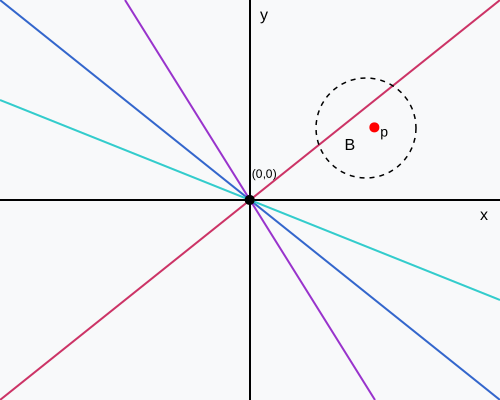
Figure 1: cannot be covered by a countable union of proper subspaces (lines through the origin).
Remark 3
Note that of course we could also prove these results using measure theory in finite dimensional spaces by using countable additivity of countable unions. The advantage of Baire’s theorem is that it easily extends to infinite dimensional vectorspaces.
Remark 4
The Baire Category Theorem holds in two important classes of topological spaces:
Complete metric spaces (and hence Banach spaces, Hilbert spaces, etc.).
Locally compact Hausdorff spaces (and hence , , and all finite-dimensional normed spaces).
In finite dimensions these overlap: is both complete and locally compact. In infinite dimensions, however, a Banach space is never locally compact (the closed unit ball is not compact), so completeness is the only route to the Baire property.
Consequences of the Baire Category Theorem
The Baire Category Theorem leads to three fundamental equivalences between the qualitative theory of continuous linear operators on Banach spaces e.g. finiteness, surjectivity to the quantitative theory e.g. estimates Tao (2009). We have already seen the first of these relationships. Recall that for a linear operator we have that
As we saw with the examples this allows us to prove the continuity of an operator by simply establishing that it is bounded (which usually is easier).
Uniform boundedness principle that equates the qualitative operators with their quantitative boundedness.
Open mapping theorem equates qualitative solvability of a linear problem with quantitative solvability.
Closed graph theorem equates the qualitative regularity of a (weakly continuous) operator with the quantitative regularity of the operator.
Remark 5
Note that these results are not used much in practice, because one usually works in the reverse direction i.e. first prove bounds, and then derive the operator’s qualitative properties. But crucially these results provide the motivation or justification of why we approach qualitative problems in functional analysis via their quantitative counter parts.
Next we will explore the uniform boundedness principle, and the open mapping theorem while we leave the closed graph theorem for later.
- Tao, T. (2009, February 1). 245B, Notes 9: The Baire category theorem and its Banach space consequences [Blog post]. https://terrytao.wordpress.com/2009/02/01/245b-notes-9-the-baire-category-theorem-and-its-banach-space-consequences/
- Hillen, T. (2023). Elements of Applied Functional Analysis. https://www.math.ualberta.ca/~thillen/FA-book-June2023.pdf