News

2026

Teaching MATH 456 and MATH 690M in Fall 2026

March 10, 2026 | Teaching

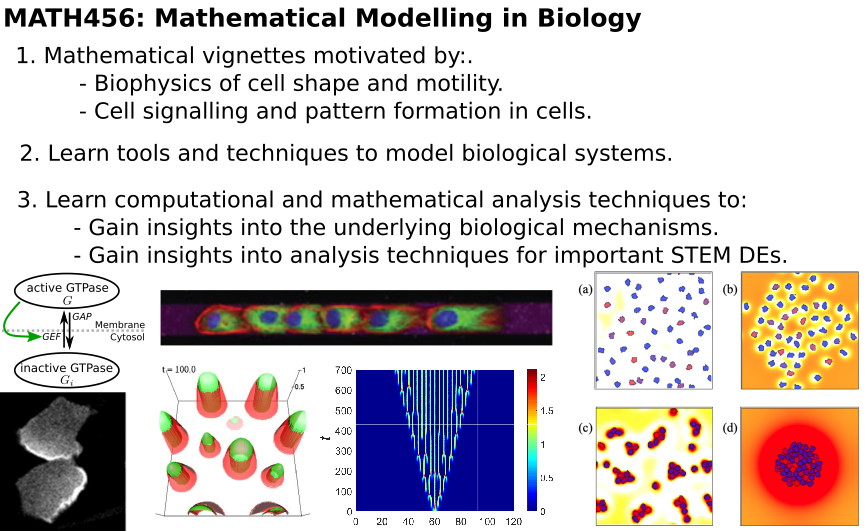
MATH 456 Advertising Poster

I’m teaching two courses in Fall 2026:

MATH 456: Math-Bio — an upper-division course focusing on mathematical approaches to modeling cellular and biological phenomena, bridging mathematics, computation, and biology.

MATH 690M: Introduction to Mathematical Biology — a graduate-level introduction to mathematical biology. Topics include:

  • Subcellular Dynamics: nonlinear ODEs and transport equations.
    • Motion in cellular world.
    • Cell structure.
    • Models for biopolymers e.g. actin and microtubules.
  • Cell polarity and directed motion: traveling waves, Turing instabilities, and pinned waves.
    • Chemotaxis.
    • Cell polarity and wave-pinning.
    • Chemotaxis and cell migration.
    • Multi-scale model introduction.
  • Patterns and waves in and between cells: reaction-diffusion equations and bifurcation theory.
    • Reaction-diffusion equations and Turing.
    • Traveling waves and spiral waves.
    • Morphogens, chemical signaling, and intracellular gradients.
  • Cell-cell interactions and collective behaviour: agent-based models and continuum limits.
    • Agent-based models for groups of cells.
    • Continuum models and nonlocal interactions.
  • Multi-scale models for cells and tissues: bridging scales from molecules to tissues.
    • Computable platform for tissues.
    • Computing a tissue.

2025

SPECIAL ISSUE: Mathematical Modeling of Cell Motility Across Scales

December 09, 2025 | Announcement

We invite you to submit your research to a special issue of the Journal of Mathematical Biology entitled “Mathematical Modeling of Cell Motility Across Scales.”

Cell motility underpins critical biological processes from development to disease, yet understanding its mechanisms requires integrating knowledge across molecular, cellular, and tissue scales. While mathematical models increasingly appear in experimental studies, rigorous mathematical analysis often remains peripheral. This special collection aims to center the quantitative frameworks that reveal organizing principles and generate testable hypotheses beyond what experimentation alone can uncover.

We seek contributions that:

  • Employ rigorous mathematical analysis to distinguish competing hypotheses
  • Identify common mathematical structures and fundamental mechanisms across cell movement systems
  • Propose theoretical frameworks that inform experimental directions
  • Utilize diverse approaches including PDEs, multiscale models, stochastic processes, mechanical models, and data-driven methods

We particularly encourage focused contributions (10–25 pages) that distill key insights through systematic analysis spanning intracellular signaling, cytoskeletal mechanics, directed migration, and collective tissue dynamics.

Submission Deadline: June 30, 2026

Collection Details

Guest Editors: Andreas Buttenschön, Calina Copos, and Dietmar Oelz

2024

2021

2020