import numpy as np
import matplotlib.pyplot as plt
from scipy.fft import dct, idct
from scipy.special import erf

plt.rcParams['figure.figsize'] = (10, 6)
plt.rcParams['font.size'] = 12
Integration as a Linear Functional
The definite integral defined by
is a continuous linear functional on the space of continuous functions:
Linear:
Continuous:
Any quadrature rule approximates this functional by a discrete linear functional:
The weights and nodes determine the accuracy.
The Chebyshev Approach
Key insight: If we represent by its Chebyshev expansion
then the integral becomes:
The integrals of Chebyshev polynomials are known exactly!
Chebyshev Integral Formula
Using the substitution , we have and:
Using the product-to-sum identity :
For :
For odd : the integral vanishes by symmetry
For even : careful evaluation gives
def chebyshev_integral_weights(n):
    """Weights for integrating Chebyshev coefficients."""
    w = np.zeros(n)
    w[0] = 2  # T_0 integrates to 2
    for k in range(2, n, 2):  # Even k >= 2
        w[k] = 2 / (1 - k**2)
    return w

# Visualize the weights
n = 20
w = chebyshev_integral_weights(n)

plt.figure(figsize=(10, 4))
plt.stem(range(n), w)
plt.xlabel('Chebyshev index $k$')
plt.ylabel('Integration weight')
plt.title('Chebyshev Integration Weights: $\int_{-1}^{1} T_k(x)\,dx$')
plt.grid(True, alpha=0.3)
plt.show()
<>:17: SyntaxWarning: invalid escape sequence '\i'
<>:17: SyntaxWarning: invalid escape sequence '\i'
/tmp/ipykernel_2816/1200403812.py:17: SyntaxWarning: invalid escape sequence '\i'
plt.title('Chebyshev Integration Weights: $\int_{-1}^{1} T_k(x)\,dx$')
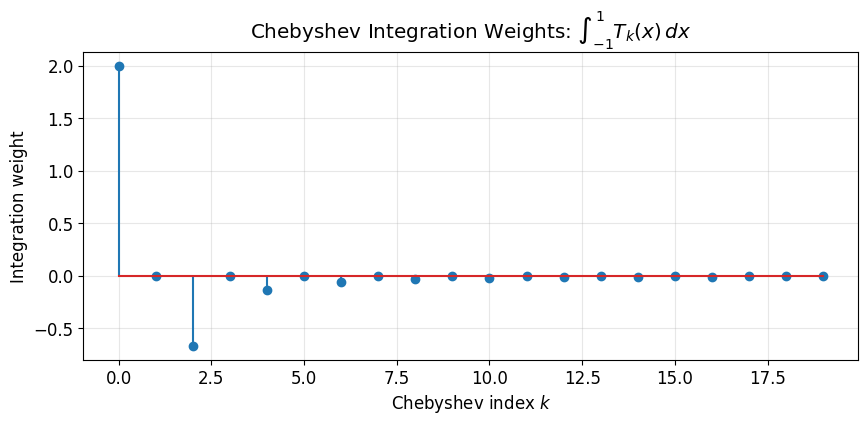
Observation: Only even-indexed coefficients contribute! Odd Chebyshev polynomials are antisymmetric about , so their integrals vanish.
Helper Functions
def chebpts(n):
    """n+1 Chebyshev points on [-1, 1]."""
    return np.cos(np.pi * np.arange(n+1) / n)

def vals2coeffs(values):
    """Convert values at Chebyshev points to Chebyshev coefficients."""
    n = len(values) - 1
    if n == 0:
        return values.copy()
    # DCT-I with proper normalization
    coeffs = dct(values[::-1], type=1) / n
    coeffs[0] /= 2
    coeffs[-1] /= 2
    return coeffs

def cheb_integrate(coeffs):
    """Integrate a function given its Chebyshev coefficients."""
    w = chebyshev_integral_weights(len(coeffs))
    return np.dot(w, coeffs)
def cheb_integrate_kahan(coeffs):
"""Integrate using Kahan summation for numerical stability.
For many terms, naive summation accumulates round-off error.
Kahan summation compensates for this.
"""
n = len(coeffs)
s = 2 * coeffs[0] # First term: integral of T_0 is 2
t = 0.0 # Error compensation term
for k in range(2, n, 2): # Only even k contribute
f = 2 * coeffs[k] / (1 - k**2)
y = f - t # Compensated term
z = s + y # New sum
t = (z - s) - y # Recover round-off error
s = z
return s
# Verify both methods give same result
n = 100
x = chebpts(n)
f = np.exp(x)
c = vals2coeffs(f)
print(f"Standard summation: {cheb_integrate(c):.15f}")
print(f"Kahan summation: {cheb_integrate_kahan(c):.15f}")
print(f"Exact value: {np.exp(1) - np.exp(-1):.15f}")Standard summation: 2.350402387287603
Kahan summation: 2.350402387287603
Exact value: 2.350402387287603
Example: Integrating 
The exact integral is .
I_exact = np.exp(1) - np.exp(-1)
print(f"Exact integral: {I_exact:.15f}")

# Chebyshev quadrature with increasing n
print("\n  n    Chebyshev approximation      Error")
print("-" * 50)
for n in [4, 8, 12, 16, 20]:
    x = chebpts(n)
    f = np.exp(x)
    c = vals2coeffs(f)
    I_approx = cheb_integrate(c)
    error = abs(I_approx - I_exact)
    print(f"{n:3d}    {I_approx:.15f}    {error:.2e}")
Exact integral: 2.350402387287603
n Chebyshev approximation Error
--------------------------------------------------
4 2.350375376931479 2.70e-05
8 2.350402387267139 2.05e-11
12 2.350402387287603 4.44e-16
16 2.350402387287603 0.00e+00
20 2.350402387287603 4.44e-16
With just 20 points, we achieve machine precision! This is spectral accuracy in action.
def trapezoidal(f, n):
    """Trapezoidal rule with n+1 equally spaced points."""
    x = np.linspace(-1, 1, n+1)
    fx = f(x)
    h = 2 / n
    return h * (0.5*fx[0] + np.sum(fx[1:-1]) + 0.5*fx[-1])

def chebyshev_quad(f, n):
    """Chebyshev quadrature with n+1 points."""
    x = chebpts(n)
    c = vals2coeffs(f(x))
    return cheb_integrate(c)
# Test function: e^x (analytic)
f = np.exp
I_exact = np.exp(1) - np.exp(-1)
ns = 2**np.arange(2, 10)
err_trap = []
err_cheb = []
for n in ns:
err_trap.append(abs(trapezoidal(f, n) - I_exact))
err_cheb.append(abs(chebyshev_quad(f, n) - I_exact))
plt.figure(figsize=(10, 6))
plt.loglog(ns, err_trap, 'o-', label='Trapezoidal', linewidth=2, markersize=8)
plt.loglog(ns, err_cheb, 's-', label='Chebyshev', linewidth=2, markersize=8)
plt.loglog(ns, 1e-16*np.ones_like(ns), 'k--', label='Machine precision', alpha=0.5)
# Reference slopes
plt.loglog(ns, 0.1/ns**2, 'r:', label=r'$O(n^{-2})$', linewidth=1.5)
plt.xlabel('Number of points $n$')
plt.ylabel('Absolute error')
plt.title(r'Integration of $e^x$: Trapezoidal vs Chebyshev')
plt.legend()
plt.grid(True, alpha=0.3)
plt.ylim([1e-17, 1])
plt.show()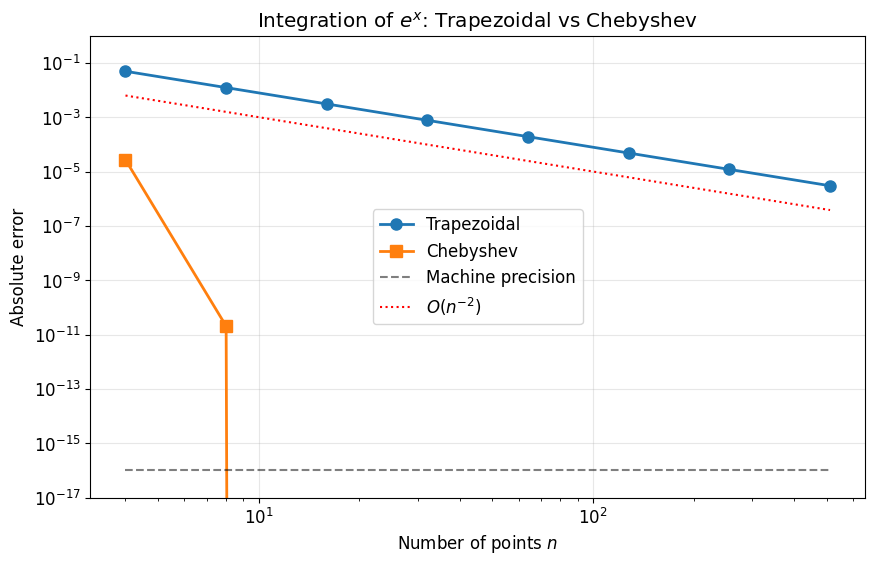
Key observation:
Trapezoidal: convergence (algebraic)
Chebyshev: convergence (exponential!)
Chebyshev reaches machine precision with ~20 points; trapezoidal would need thousands.
Effect of Smoothness
The convergence rate depends on the smoothness of . Let’s compare:
Analytic: — exponential convergence
: — algebraic convergence
: — algebraic convergence
# Define test functions and exact integrals
functions = [
    (lambda x: np.exp(x), np.exp(1) - np.exp(-1), r'$e^x$ (analytic)'),
    (lambda x: np.abs(np.sin(5*x))**3, (24 + 9*np.cos(5) - np.cos(15))/30, r'$|\sin(5x)|^3$ ($C^3$)'),
    (lambda x: np.abs(x), 1.0, r'$|x|$ ($C^0$)'),
]

ns = 2**np.arange(2, 12)

fig, axes = plt.subplots(1, 3, figsize=(15, 5))

for ax, (f, I_exact, label) in zip(axes, functions):
    err_trap = [abs(trapezoidal(f, n) - I_exact) for n in ns]
    err_cheb = [abs(chebyshev_quad(f, n) - I_exact) for n in ns]

    ax.loglog(ns, err_trap, 'o-', label='Trapezoidal', linewidth=2)
    ax.loglog(ns, err_cheb, 's-', label='Chebyshev', linewidth=2)
    ax.loglog(ns, 1e-16*np.ones_like(ns), 'k--', alpha=0.5)

    ax.set_xlabel('$n$')
    ax.set_ylabel('Error')
    ax.set_title(label)
    ax.legend()
    ax.grid(True, alpha=0.3)
    ax.set_ylim([1e-17, 10])

plt.tight_layout()
plt.show()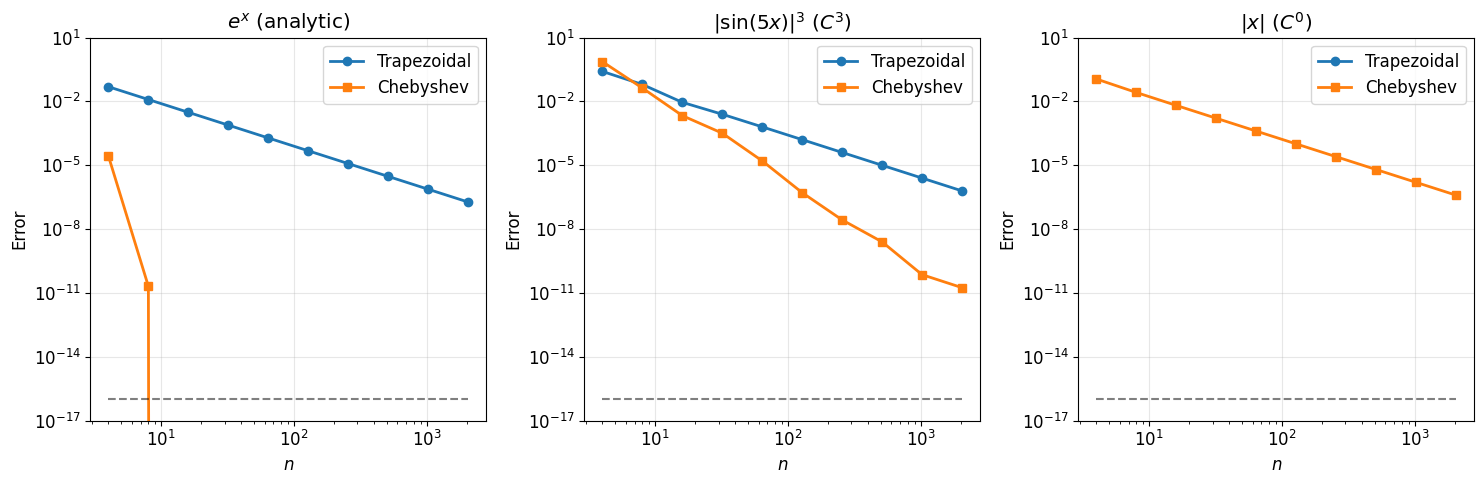
Why the Difference?
Trapezoidal rule:
Approximates by piecewise linear functions
Error depends on (curvature)
Always , regardless of smoothness
Chebyshev quadrature:
Approximates by a polynomial of degree
Error is the integral of the approximation error:
For analytic functions: (exponential!)
For functions:
The polynomial approximation error controls the quadrature error. This is why Chebyshev quadrature inherits the spectral convergence of Chebyshev interpolation.
Observations:
For the analytic function : Chebyshev converges exponentially
For : Chebyshev converges as , still faster than trapezoidal’s
For : Both methods struggle, but Chebyshev still wins
Clenshaw-Curtis Weights
We can express Chebyshev quadrature directly in value space as:
where are Chebyshev points and are the Clenshaw-Curtis weights.
This is equivalent to our coefficient-based approach but avoids the explicit DCT.
Convergence Theorem
The convergence rate matches the coefficient decay:
: Error
analytic: Error (exponential!)
For large , Clenshaw-Curtis quadrature is essentially as accurate as Gaussian quadrature, but uses points that are easier to work with (nested, explicit formulas).
def clenshaw_curtis_weights(n):
    """Compute Clenshaw-Curtis quadrature weights."""
    if n == 0:
        return np.array([2.0])

    # Integration weights for Chebyshev coefficients
    int_weights = chebyshev_integral_weights(n+1)

    # Transform from coefficient space to value space
    # w_k = sum_j (int_weights[j] * T_j(x_k) * normalization)
    x = chebpts(n)
    theta = np.arccos(x)

    w = np.zeros(n+1)
    for k in range(n+1):
        for j in range(n+1):
            # T_j(x_k) = cos(j * theta_k)
            factor = 1.0 if (j == 0 or j == n) else 2.0
            w[k] += int_weights[j] * np.cos(j * theta[k]) / factor
        w[k] /= n

    return w

# Visualize the weights
for n in [8, 16, 32]:
    x = chebpts(n)
    w = clenshaw_curtis_weights(n)
    plt.plot(x, w, 'o-', label=f'n={n}', markersize=4)

plt.xlabel('$x$')
plt.ylabel('Weight $w_k$')
plt.title('Clenshaw-Curtis Quadrature Weights')
plt.legend()
plt.grid(True, alpha=0.3)
plt.show()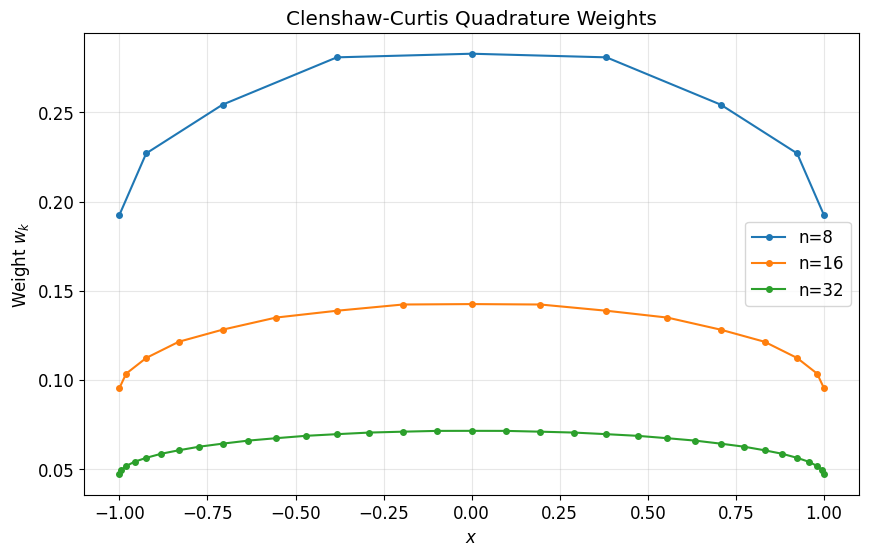
Note: The weights are largest near the center and smaller at the endpoints—compensating for the clustering of Chebyshev points near .
Why the Functional Perspective Matters
Viewing integration as a functional clarifies several points:
Linearity: Quadrature rules inherit linearity from the integral
Error analysis: The error is where is the interpolant
Optimality: Gaussian quadrature is optimal among rules of a given polynomial degree
Generalization: Same ideas apply to weighted integrals
def integrate_ab(f, a, b, n):
    """Chebyshev quadrature on [a, b]."""
    t = chebpts(n)
    x = (b - a) / 2 * t + (a + b) / 2
    c = vals2coeffs(f(x))
    return (b - a) / 2 * cheb_integrate(c)

# Example: integrate sin(x) from 0 to pi
I_exact = 2.0  # -cos(pi) + cos(0) = 2
I_approx = integrate_ab(np.sin, 0, np.pi, 20)
print(f"Integral of sin(x) from 0 to pi:")
print(f"  Exact:  {I_exact}")
print(f"  Approx: {I_approx:.15f}")
print(f"  Error:  {abs(I_approx - I_exact):.2e}")
Integral of sin(x) from 0 to pi:
Exact: 2.0
Approx: 2.000000000000000
Error: 0.00e+00
Summary
| Method | Convergence () | Convergence (analytic) | Cost |
|---|---|---|---|
| Trapezoidal | |||
| Chebyshev |
Key insight: Chebyshev quadrature inherits the approximation accuracy of Chebyshev interpolation. For smooth functions, this means exponential convergence—reaching machine precision with remarkably few points.