Use Taylor’s theorem to derive finite difference approximations for derivatives and analyze their accuracy. Understanding the interplay between approximation error and round-off error is fundamental to scientific computing.
Statement of Taylor’s Theorem
Theorem 1 (Taylor’s Theorem)
Suppose we have a function with continuous derivatives, and let then we can write:
where . This means that the approximation error is:
Remark 1 (Key Properties of Taylor Polynomials)
When we let , becomes the Taylor series.
Given the polynomial , we have:
In fact, is the unique polynomial of degree such that for .
Example 1 (Computing to a Given Accuracy)
Suppose we want to compute the number to an accuracy of 10-3.
We can do this by computing a Taylor series for the function . Since we know the value at , namely , we use that as the point about which we create the Taylor series.
Since , we have for all .
The -degree Taylor polynomial is:
To estimate the error, we compute the remainder:
where . Since is positive and increasing:
To achieve the required accuracy:
With some experimentation, we find that the first for which this inequality holds is .
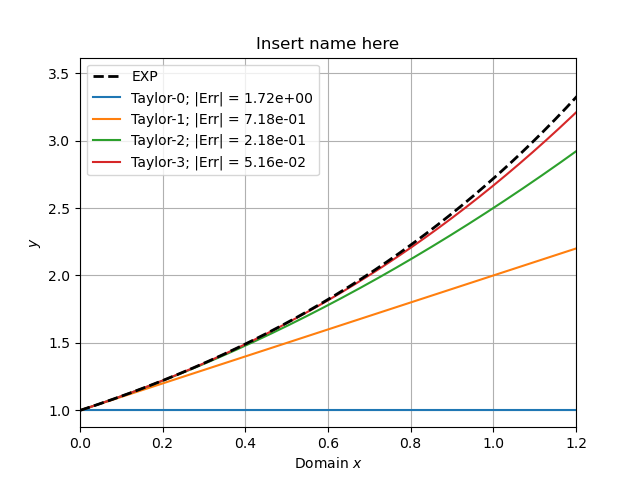
The first four Taylor polynomials of centered at . The approximations converge to the true function (dashed black) as the degree increases.
Why Taylor’s Theorem Matters
Taylor’s theorem is a workhorse of numerical analysis because:
It allows us to replace complicated functions with polynomials
The remainder term gives us explicit error bounds
It reveals how accuracy depends on the step size
In the next section, we’ll use Taylor’s theorem to derive finite difference approximations for derivatives.