This notebook demonstrates fixed point iteration for solving nonlinear equations, showing how convergence depends on the choice of iteration function .
import numpy as np
import matplotlib.pyplot as plt
The Problem: Finding 
We want to solve , i.e., find .
Fixed point iteration rewrites this as and iterates .
Key question: How does the choice of affect convergence?
# True root
x_true = np.sqrt(3)

def fixed_point_iteration(g, x0, max_iter=20, tol=1e-12):
    """Run fixed point iteration and return history."""
    history = [(0, x0, abs(x0 - x_true))]
    x = x0

    for n in range(1, max_iter + 1):
        try:
            x_new = g(x)
            error = abs(x_new - x_true)
            history.append((n, x_new, error))

            if abs(x_new - x) < tol:
                break
            x = x_new
        except:
            break

    return history

def print_history(history, name):
    """Print iteration history."""
    print(f"\n{name}:")
    print(f"{'n':>3} | {'x_n':>14} | {'Error':>12}")
    print("-" * 35)
    for n, x, err in history[:8]:
        print(f"{n:3d} | {x:14.10f} | {err:12.2e}")
    if len(history) > 8:
        print("...")
        n, x, err = history[-1]
print(f"{n:3d} | {x:14.10f} | {err:12.2e}")g1 = lambda x: 3.0 / x
history1 = fixed_point_iteration(g1, x0=1.25, max_iter=10)
print_history(history1, "g₁(x) = 3/x")
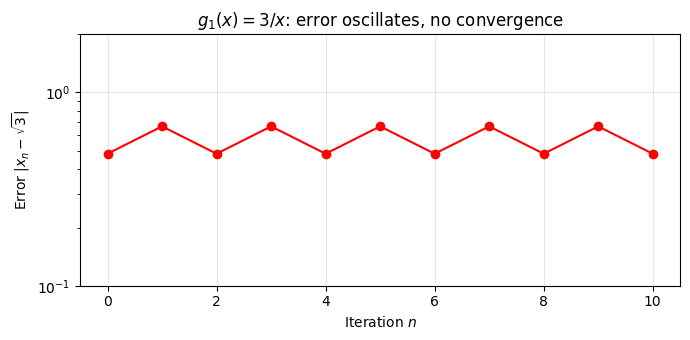
print(f"\n|g₁'(√3)| = {abs(-3/3):.2f} — oscillates without converging!")
# Convergence plot
fig, ax = plt.subplots(figsize=(7, 3.5))
errors1 = [e for _, _, e in history1]
ax.semilogy(range(len(errors1)), errors1, 'ro-', markersize=6)
ax.set_xlabel('Iteration $n$')
ax.set_ylabel(r'Error $|x_n - \sqrt{3}|$')
ax.set_title(r'$g_1(x) = 3/x$: error oscillates, no convergence')
ax.grid(True, alpha=0.3)
ax.set_ylim(1e-1, 2)
plt.tight_layout()
plt.show()
g₁(x) = 3/x:
  n |            x_n |        Error
-----------------------------------
  0 |   1.2500000000 |     4.82e-01
  1 |   2.4000000000 |     6.68e-01
  2 |   1.2500000000 |     4.82e-01
  3 |   2.4000000000 |     6.68e-01
  4 |   1.2500000000 |     4.82e-01
  5 |   2.4000000000 |     6.68e-01
  6 |   1.2500000000 |     4.82e-01
  7 |   2.4000000000 |     6.68e-01
...
 10 |   1.2500000000 |     4.82e-01

|g₁'(√3)| = 1.00 — oscillates without converging!
Example 2: (Slow Convergence)
This comes from a gradient descent-style approach.
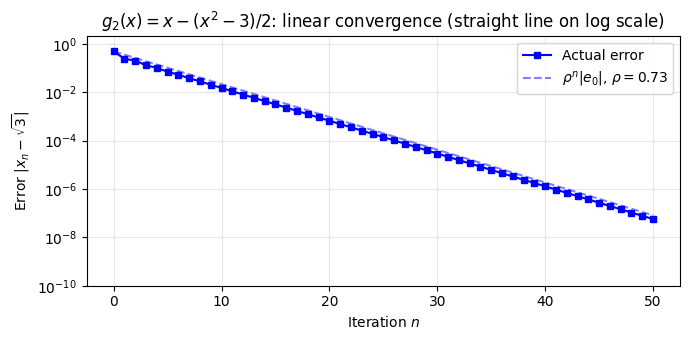
We have , so . Converges, but slowly.
g2 = lambda x: x - 0.5 * (x**2 - 3)

history2 = fixed_point_iteration(g2, x0=1.25, max_iter=50)
print_history(history2, "g₂(x) = x - (x² - 3)/2")

rho2 = abs(1 - x_true)
print(f"\n|g₂'(√3)| = {rho2:.4f} — linear convergence")

# Convergence plot
fig, ax = plt.subplots(figsize=(7, 3.5))
errors2 = [e for _, _, e in history2]
n2 = np.arange(len(errors2))
ax.semilogy(n2, errors2, 'bs-', markersize=4, label='Actual error')
ax.semilogy(n2, errors2[0] * rho2**n2, 'b--', alpha=0.5,
            label=rf'$\rho^n |e_0|$, $\rho = {rho2:.2f}$')
ax.set_xlabel('Iteration $n$')
ax.set_ylabel(r'Error $|x_n - \sqrt{3}|$')
ax.set_title(r'$g_2(x) = x - (x^2-3)/2$: linear convergence (straight line on log scale)')
ax.legend()
ax.grid(True, alpha=0.3)
ax.set_ylim(1e-10, 2)
plt.tight_layout()
plt.show()
g₂(x) = x - (x² - 3)/2:
  n |            x_n |        Error
-----------------------------------
  0 |   1.2500000000 |     4.82e-01
  1 |   1.9687500000 |     2.37e-01
  2 |   1.5307617188 |     2.01e-01
  3 |   1.8591459990 |     1.27e-01
  4 |   1.6309340762 |     1.01e-01
  5 |   1.8009610957 |     6.89e-02
  6 |   1.6792306616 |     5.28e-02
  7 |   1.7693228542 |     3.73e-02
...
 50 |   1.7320507510 |     5.66e-08

|g₂'(√3)| = 0.7321 — linear convergence
Example 3: (Fast Convergence)
This is the Babylonian method (Newton’s method for square roots).
We have , so .
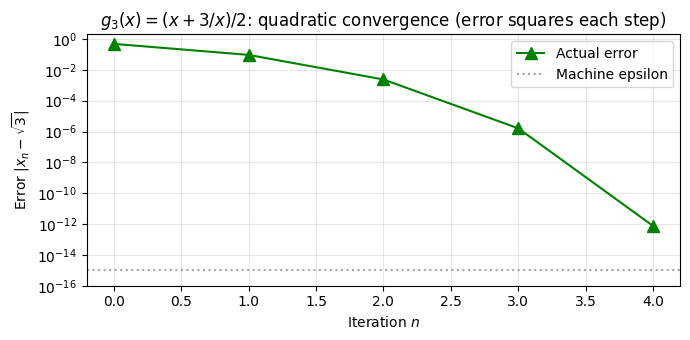
When , we get quadratic convergence!
g3 = lambda x: 0.5 * (x + 3.0 / x)

history3 = fixed_point_iteration(g3, x0=1.25, max_iter=10)
print_history(history3, "g₃(x) = (x + 3/x)/2  [Babylonian/Newton]")

print(f"\ng₃'(√3) = {0.5 * (1 - 3/3):.1f} — quadratic convergence!")

# Convergence plot
fig, ax = plt.subplots(figsize=(7, 3.5))
errors3 = [e for _, _, e in history3 if e > 0]
ax.semilogy(range(len(errors3)), errors3, 'g^-', markersize=8, label='Actual error')
ax.axhline(y=1e-15, color='gray', linestyle=':', alpha=0.7, label='Machine epsilon')
ax.set_xlabel('Iteration $n$')
ax.set_ylabel(r'Error $|x_n - \sqrt{3}|$')
ax.set_title(r"$g_3(x) = (x+3/x)/2$: quadratic convergence (error squares each step)")
ax.legend()
ax.grid(True, alpha=0.3)
ax.set_ylim(1e-16, 2)
plt.tight_layout()
plt.show()
g₃(x) = (x + 3/x)/2  [Babylonian/Newton]:
  n |            x_n |        Error
-----------------------------------
  0 |   1.2500000000 |     4.82e-01
  1 |   1.8250000000 |     9.29e-02
  2 |   1.7344178082 |     2.37e-03
  3 |   1.7320524227 |     1.62e-06
  4 |   1.7320508076 |     7.53e-13
  5 |   1.7320508076 |     0.00e+00

g₃'(√3) = 0.0 — quadratic convergence!
Convergence Comparison
Let’s visualize the dramatic difference in convergence rates.
fig, (ax1, ax2) = plt.subplots(1, 2, figsize=(12, 5))

# Left: Error vs iteration (all three)
errors1 = [e for _, _, e in history1]
errors2 = [e for _, _, e in history2]
errors3 = [e for _, _, e in history3 if e > 0]

ax1.semilogy(range(len(errors1)), errors1, 'ro-', markersize=6, label=r'$g_1(x) = 3/x$ (diverges)')
ax1.semilogy(range(len(errors2)), errors2, 'bs-', markersize=4, label=r'$g_2(x) = x - (x^2-3)/2$ (linear)')
ax1.semilogy(range(len(errors3)), errors3, 'g^-', markersize=6, label=r'$g_3(x) = (x+3/x)/2$ (quadratic)')

ax1.axhline(y=1e-15, color='gray', linestyle=':', alpha=0.7)
ax1.set_xlabel('Iteration $n$', fontsize=12)
ax1.set_ylabel(r'Error $|x_n - \sqrt{3}|$', fontsize=12)
ax1.set_title('Convergence Comparison', fontsize=14)
ax1.legend(fontsize=9)
ax1.grid(True, alpha=0.3)
ax1.set_ylim(1e-16, 10)

# Right: Cobweb diagram for g3
x = np.linspace(0.5, 2.5, 200)
ax2.plot(x, x, 'k-', linewidth=1, label='$y = x$')
ax2.plot(x, g3(x), 'g-', linewidth=2, label=r'$y = g_3(x)$')

# Cobweb
x_curr = 1.25
for _ in range(5):
    x_next = g3(x_curr)
    ax2.plot([x_curr, x_curr], [x_curr, x_next], 'b-', alpha=0.6, linewidth=1)
    ax2.plot([x_curr, x_next], [x_next, x_next], 'b-', alpha=0.6, linewidth=1)
    x_curr = x_next

ax2.plot(x_true, x_true, 'ro', markersize=8, label=r'Fixed point $\sqrt{3}$')
ax2.set_xlabel('$x$', fontsize=12)
ax2.set_ylabel('$y$', fontsize=12)
ax2.set_title('Cobweb Diagram for $g_3$', fontsize=14)
ax2.legend(fontsize=10)
ax2.grid(True, alpha=0.3)
ax2.set_xlim(0.5, 2.5)
ax2.set_ylim(0.5, 2.5)
ax2.set_aspect('equal')

plt.tight_layout()
plt.show()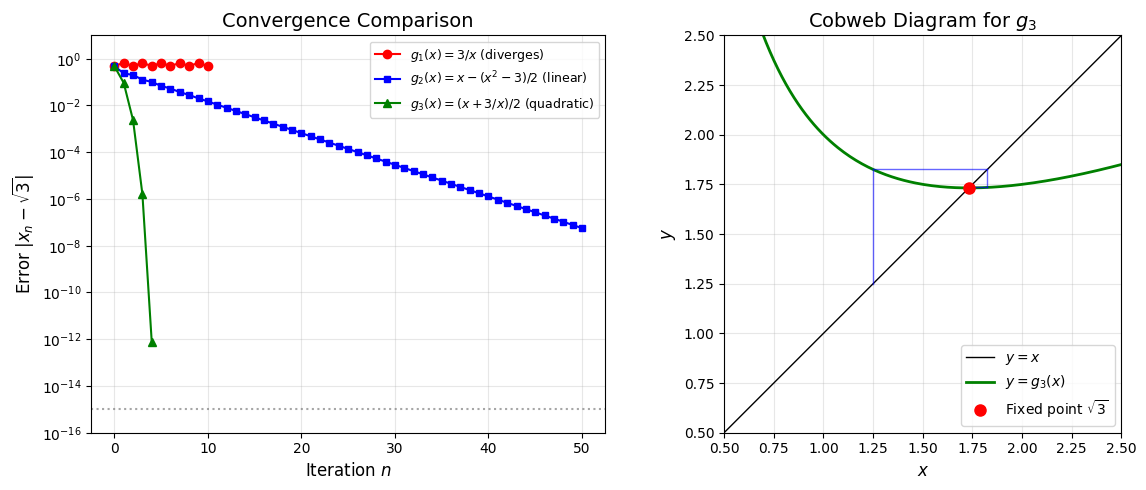
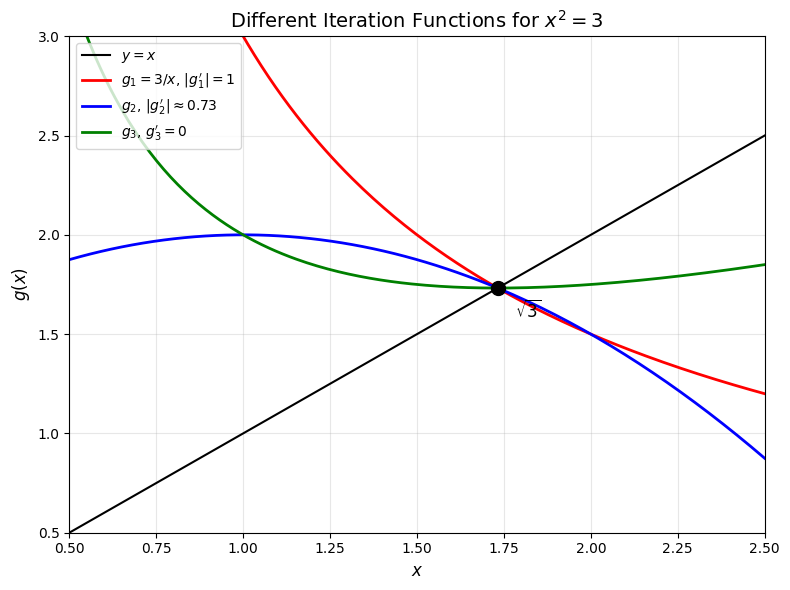
The Role of 
The convergence rate depends critically on the derivative at the fixed point:
| Condition | Convergence |
|---|---|
| $ | g’(c) |
| $ | g’(c) |
| $ | g’(c) |
| Quadratic convergence |
Key insight: Newton’s method achieves by construction!
# Visualize derivative condition
fig, ax = plt.subplots(figsize=(8, 6))

x = np.linspace(0.5, 2.5, 200)

ax.plot(x, x, 'k-', linewidth=1.5, label='$y = x$')
ax.plot(x, g1(x), 'r-', linewidth=2, label=r"$g_1 = 3/x$, $|g_1'| = 1$")
ax.plot(x, g2(x), 'b-', linewidth=2, label=r"$g_2$, $|g_2'| \approx 0.73$")
ax.plot(x, g3(x), 'g-', linewidth=2, label=r"$g_3$, $g_3' = 0$")

ax.plot(x_true, x_true, 'ko', markersize=10, zorder=5)
ax.annotate(r'$\sqrt{3}$', (x_true + 0.05, x_true - 0.15), fontsize=12)

ax.set_xlabel('$x$', fontsize=12)
ax.set_ylabel('$g(x)$', fontsize=12)
ax.set_title('Different Iteration Functions for $x^2 = 3$', fontsize=14)
ax.legend(loc='upper left', fontsize=10)
ax.grid(True, alpha=0.3)
ax.set_xlim(0.5, 2.5)
ax.set_ylim(0.5, 3)

plt.tight_layout()
plt.show()