is a linear functional on . Restricted to it is just a row vector of weights acting on the nodal values: . There are two natural representations. Value-space quadrature sets and sums against the nodal values . Coefficient-space integration expands in Chebyshev polynomials and integrates each using a closed-form identity. On Chebyshev nodes both reduce to the same rule, Clenshaw-Curtis quadrature, with spectral accuracy for smooth integrands.
Quadrature in Value Space¶
The quadrature framework is simple. Sample at nodes , build the Lagrange interpolant , and integrate:
The continuous integral has become a finite-dimensional inner product: the value vector tested against the weight vector . Once the nodes are fixed, the quadrature weights are purely geometric and can be computed once and reused for any .
Trapezoidal uses the hat basis on an equispaced grid and gets the familiar weights (with at the endpoints). Newton-Cotes generalises this to higher-degree polynomial interpolation on equispaced nodes, but as in §2 it suffers from Runge at large . The weights start to alternate in sign and grow exponentially, turning the sum into catastrophic cancellation. Don’t go that route.
Chebyshev nodes fix it, as always. On them the integrals are bounded and positive. Computing them directly from the barycentric form of is cumbersome, but we already have the right machinery. In the next section we expand in the Chebyshev basis and integrate there; afterwards we translate back to read off the explicit weights.
Integration in Coefficient Space¶
Expand in the Chebyshev basis
and integrate term by term using linearity:
Everything reduces to the closed-form values of , which come cleanly out of the substitution.
Proposition 1 (Integrals of Chebyshev polynomials)
Proof 1
Let , so and . The integral becomes
Apply the product-to-sum identity to split the integral into
Each piece uses , which equals for odd and 0 for even.
If is even, both and are odd, giving .
If is odd with , both and are even, and both integrals vanish.
At the formula reduces directly to , matching .
Plugging the proposition into the term-by-term sum collapses the integral of to a clean one-liner:
Only the even-index Chebyshev coefficients contribute. Operationally: compute in , then dot it against the integral vector from Proposition 1.
Clenshaw-Curtis: Back to Value-Space Weights¶
Chaining the two views gives the value-space weights we promised. Writing for the integrals from Proposition 1, the coefficient-space integral is
From Where to Place the Nodes the discrete Chebyshev coefficients are
where halves the and terms. Substituting this into the coefficient-space integral,
and swapping the order of summation,
The inner sum in brackets defines the Clenshaw-Curtis weights. Only the even contribute, since for odd. So
with an extra factor of at the endpoints coming from the outer . The closed form is a finite cosine series in ; evaluating it at produces the whole weight vector in work, or with an FFT.
import numpy as np
import matplotlib.pyplot as plt
import scipy.fft as fft

def chebpts(N):
    return np.cos(np.pi * np.arange(N+1) / N)

def cc_weights(N):
    """Clenshaw-Curtis weights on Chebyshev points x_j = cos(j*pi/N),
    from Trefethen's clencurt.m."""
    theta = np.pi * np.arange(N+1) / N
    w = np.zeros(N+1)
    v = np.ones(N-1)
    if N % 2 == 0:
        w[0] = 1.0 / (N**2 - 1); w[N] = w[0]
        for k in range(1, N//2):
            v -= 2 * np.cos(2*k*theta[1:N]) / (4*k**2 - 1)
        v -= np.cos(N*theta[1:N]) / (N**2 - 1)
    else:
        w[0] = 1.0 / N**2; w[N] = w[0]
        for k in range(1, (N-1)//2 + 1):
            v -= 2 * np.cos(2*k*theta[1:N]) / (4*k**2 - 1)
    w[1:N] = 2 * v / N
    return w

N = 32
w = cc_weights(N); x = chebpts(N)
fig, ax = plt.subplots(figsize=(7, 3.8))
ax.stem(np.arange(N+1), w, basefmt=' ')
ax.set_xlabel('node index $j$'); ax.set_ylabel('$w_j$')
ax.set_title(f'Clenshaw-Curtis weights, $N = {N}$ (all positive)')
plt.tight_layout(); plt.show()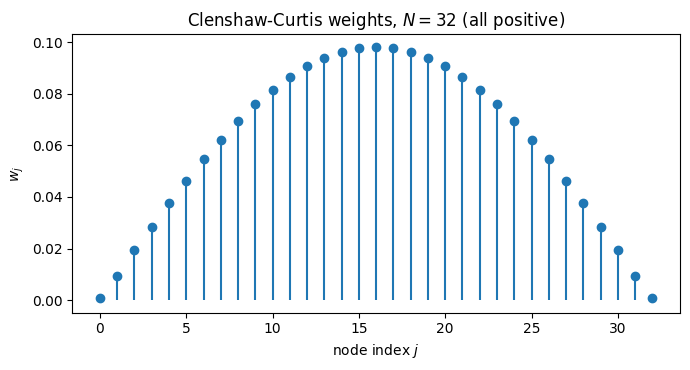
All weights are positive, so the quadrature never relies on delicate sign cancellation. The endpoint weights are small to compensate for the endpoint clustering of Chebyshev nodes: each node sits in a region of size in the interior and near , and the weights mirror that. Contrast with Newton-Cotes at large , where weights alternate sign and grow exponentially.
Convergence¶
The quadrature error inherits the truncation error of the Chebyshev expansion, so the rates from Regularity and Coefficient Decay translate directly.
Theorem 1 (Clenshaw-Curtis convergence rates)
Proof 2
By construction, for the Chebyshev interpolant of . So
Cases (1) and (2) follow by applying the interpolant rates from Corollary 1 combined with the Lebesgue-constant bound from the same chapter; the log factor is absorbed into the . For case (3) the bound on fails, but the coefficient tail summed against the quadrature integral vector gives .
from scipy.special import erf

def trapezoid(f, N):
    x = np.linspace(-1, 1, N+1); h = x[1] - x[0]
    fx = f(x)
    return h * (fx[0]/2 + fx[-1]/2 + fx[1:-1].sum())

def cc(f, N):
    x = chebpts(N); return cc_weights(N) @ f(x)

# (a) Analytic integrand
f1 = lambda x: np.exp(-x**2)
I1 = np.sqrt(np.pi) * erf(1.0)

# (b) C^2 integrand: |x|^3
f2 = lambda x: np.abs(x)**3
I2 = 0.5

Ns = 2**np.arange(2, 11)
err_t1 = [abs(trapezoid(f1, N) - I1) for N in Ns]
err_c1 = [abs(cc(f1, N)        - I1) for N in Ns]
err_t2 = [abs(trapezoid(f2, N) - I2) for N in Ns]
err_c2 = [abs(cc(f2, N)        - I2) for N in Ns]

fig, (ax1, ax2) = plt.subplots(1, 2, figsize=(10, 4))
ax1.loglog(Ns, err_t1, 'o-', label='trapezoid')
ax1.loglog(Ns, err_c1, 's-', label='Clenshaw-Curtis')
ax1.set_title(r'analytic: $\int_{-1}^{1} e^{-x^2} dx$')
ax1.set_xlabel('$N$'); ax1.set_ylabel('error'); ax1.legend()

ax2.loglog(Ns, err_t2, 'o-', label='trapezoid')
ax2.loglog(Ns, err_c2, 's-', label='Clenshaw-Curtis')
ax2.loglog(Ns, 1.0/Ns**4, 'k:', label=r'$N^{-4}$')
ax2.set_title(r'$C^2$: $\int_{-1}^{1} |x|^3 dx$')
ax2.set_xlabel('$N$'); ax2.legend()
plt.tight_layout(); plt.show()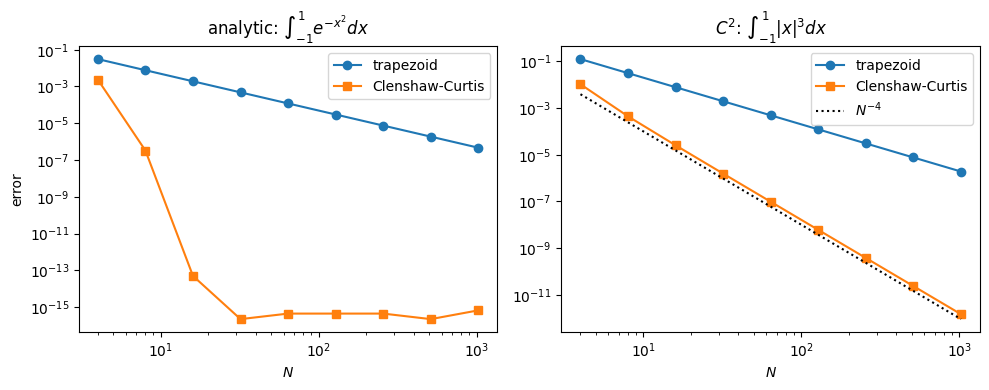
The analytic integrand drops to machine precision around under Clenshaw-Curtis; trapezoid plods along at . For the integrand both rules eventually drop algebraically, but Clenshaw-Curtis benefits from each extra derivative the integrand has, while trapezoid is permanently stuck at second order.
A Demo¶
Try the rule on something genuinely awful. The integrand
oscillates 40 times across , has an envelope that itself rides on , and admits no closed-form antiderivative. It is, however, real-analytic on , so the regularity dictionary predicts geometric convergence once the resolution is high enough to see the oscillation.
def g(x):
    return np.exp(x) * np.cosh(4*np.sin(40*x))**(-np.exp(x))

xx = np.linspace(-1, 1, 4000)
fig, axes = plt.subplots(1, 2, figsize=(11, 4))
axes[0].plot(xx, g(xx), 'C2', lw=0.6)
axes[0].set_xlabel('$x$')
axes[0].set_title(r"$g(x) = e^x [\mathrm{sech}(4\sin 40x)]^{e^x}$")

I_ref = cc(g, 4096)
Ns = 2**np.arange(4, 13)
err_cc    = [abs(cc(g, N)        - I_ref) for N in Ns]
err_trapz = [abs(trapezoid(g, N) - I_ref) for N in Ns]

axes[1].loglog(Ns, err_cc,    'o-', label='Clenshaw-Curtis')
axes[1].loglog(Ns, err_trapz, 's-', label='trapezoid')
axes[1].set_xlabel('$N$'); axes[1].set_ylabel(r'error vs. $I_{4096}$')
axes[1].set_title('Convergence on the wild integrand')
axes[1].legend()
plt.tight_layout(); plt.show()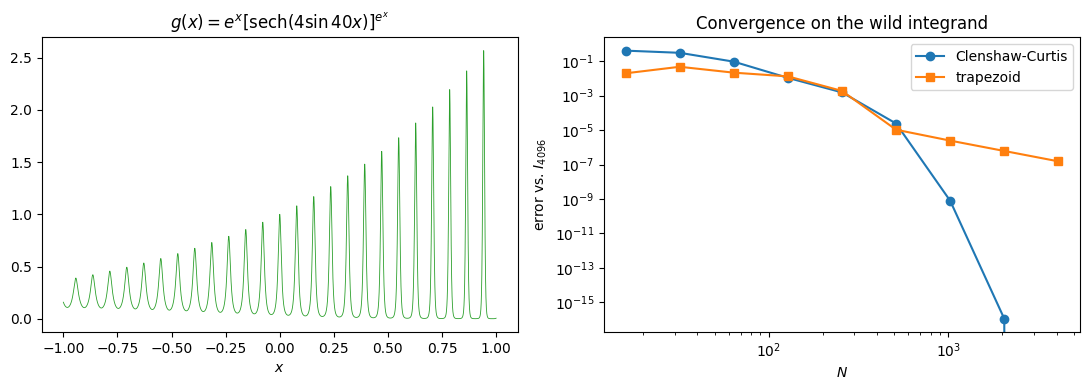
Two regimes, separated by a knee where Clenshaw-Curtis finally resolves the oscillation. Below the knee the integrand looks rougher than can capture and both rules flounder. Above it, Clenshaw-Curtis switches to its asymptotic geometric rate and reaches machine precision within a handful of doublings. Trapezoid, blind to the analyticity, plods on at throughout.
The take-away: spectral convergence is a promise about the asymptotic regime, contingent on resolving whatever oscillations the integrand already has. Once you cross that threshold, the difference between the two rules is no longer a constant factor. It is the difference between “correct to all digits” and “still wrong in the second.”