Real-world problems often have multiple roots, and we need to find all of them
reliably. This requires combining bracketing (to isolate roots) with
fast solvers (to compute them accurately). Production solvers like MATLAB’s
fzero and SciPy’s
brentq
use hybrid methods that get the best of both worlds.
The Challenge: Multiple Roots
So far we have studied methods that converge to one root:
Bisection is safe but slow, and requires a bracket with .
Newton’s method is fast but local: it converges to whichever root is nearest (roughly), and may miss others entirely.
In practice, a function can have many roots, and we need a systematic way to find them all.
Example 1 (Multiple Roots)
Consider . There are three roots at . Starting Newton’s method from converges to . Starting from converges to (not the nearest root ). There is no single starting point that finds all three.
Bracketing
The first step is to isolate each root in its own interval. The simplest approach: evaluate on a grid and look for sign changes.
Algorithm 1 (Sign-Change Scanning)
Input: Function , interval , number of sample points
Output: List of brackets with
Set
for :
,
if : record bracket
By the Intermediate Value Theorem, each bracket contains at least one root.
Remark 1 (Limitations of Sign-Change Scanning)
This approach can miss roots in two situations:
Even-multiplicity roots (e.g., ): the function touches zero but does not change sign, so no bracket is detected.
Closely spaced roots: if two roots are closer than the grid spacing , they may fall in the same interval. The sign change detects only one bracket, and bisection/Newton applied to that bracket may find only one of the two roots.
A finer grid reduces the chance of missing roots but increases the cost.
import numpy as np
import matplotlib.pyplot as plt

f = lambda x: x**3 - 6*x**2 + 11*x - 6

x = np.linspace(-0.5, 4, 500)
fig, ax = plt.subplots(figsize=(8, 4))
ax.plot(x, f(x), 'b-', linewidth=2)
ax.axhline(0, color='k', linewidth=0.8)

# Sign-change scanning
N = 20
x_grid = np.linspace(-0.5, 4, N + 1)
f_grid = f(x_grid)

brackets = []
for i in range(N):
    if f_grid[i] * f_grid[i + 1] < 0:
        brackets.append((x_grid[i], x_grid[i + 1]))
        ax.axvspan(x_grid[i], x_grid[i + 1], alpha=0.2, color='green')

# Mark roots
roots = [1, 2, 3]
for r in roots:
    ax.plot(r, 0, 'ro', markersize=8, zorder=5)

ax.set_xlabel('$x$')
ax.set_ylabel('$f(x)$')
ax.set_title(f'Sign-change scanning: {len(brackets)} brackets found (green)')
ax.grid(True, alpha=0.3)
ax.set_ylim(-3, 3)
plt.tight_layout()
plt.show()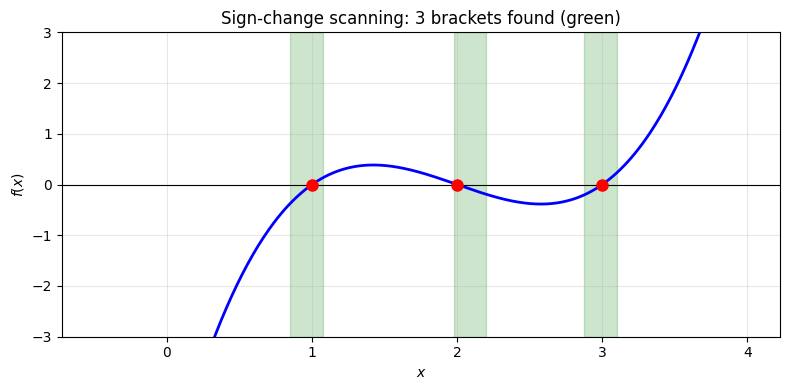
Finding All Roots
Once we have brackets, apply a fast solver to each one independently. This is the bracket-then-solve strategy.
Algorithm 2 (Find All Roots)
Input: Function , interval , grid size , tolerance
Output: List of all detected roots
Scan: evaluate on a grid of points in .
Bracket: identify all intervals where changes sign.
Solve: apply Brent’s method (or Newton-bisection) to each bracket.
Deduplicate: remove any roots that are within of each other.
from scipy.optimize import brentq

def find_all_roots(f, a, b, N=1000, tol=1e-12):
    """Find all sign-change roots of f on [a, b]."""
    x_grid = np.linspace(a, b, N + 1)
    f_grid = f(x_grid)

    roots = []
    for i in range(N):
        if f_grid[i] * f_grid[i + 1] < 0:
            root = brentq(f, x_grid[i], x_grid[i + 1], xtol=tol)
            # Deduplicate
            if not roots or abs(root - roots[-1]) > 10 * tol:
                roots.append(root)
    return roots

# Example: find all roots of a more complex function
g = lambda x: np.sin(5*x) * np.exp(-x/3) - 0.1

roots_found = find_all_roots(g, 0, 10)

fig, ax = plt.subplots(figsize=(10, 4))
x = np.linspace(0, 10, 1000)
ax.plot(x, g(x), 'b-', linewidth=2)
ax.axhline(0, color='k', linewidth=0.8)
for r in roots_found:
    ax.plot(r, 0, 'ro', markersize=8, zorder=5)
ax.set_xlabel('$x$')
ax.set_ylabel('$f(x)$')
ax.set_title(f'Found {len(roots_found)} roots of $\\sin(5x) e^{{-x/3}} - 0.1$')
ax.grid(True, alpha=0.3)
plt.tight_layout()
plt.show()

print("Roots found:")
for i, r in enumerate(roots_found):
    print(f"  x_{i} = {r:.10f},  f(x_{i}) = {g(r):.2e}")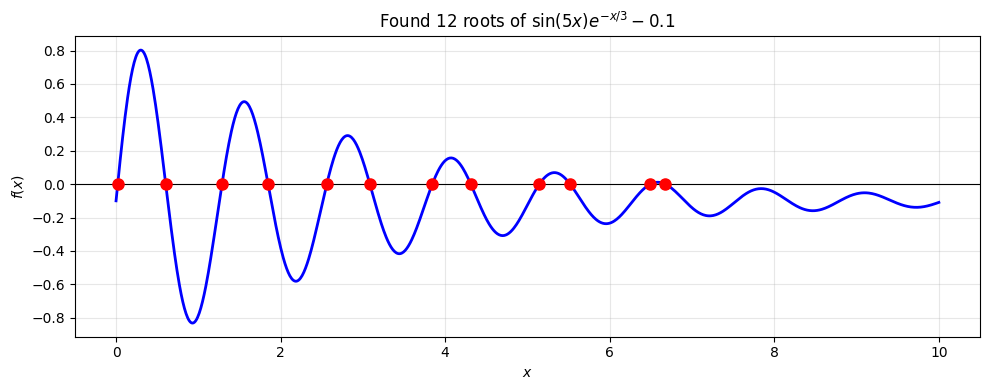
Roots found:
  x_0 = 0.0201690821,  f(x_0) = 0.00e+00
  x_1 = 0.6037981464,  f(x_1) = -1.25e-16
  x_2 = 1.2874784697,  f(x_2) = 3.92e-14
  x_3 = 1.8477141366,  f(x_3) = -5.55e-16
  x_4 = 2.5606764392,  f(x_4) = -3.19e-16
  x_5 = 3.0849105381,  f(x_5) = 6.59e-15
  x_6 = 3.8435849184,  f(x_6) = -1.49e-13
  x_7 = 4.3113522549,  f(x_7) = 4.36e-15
  x_8 = 5.1443525356,  f(x_8) = -1.80e-16
  x_9 = 5.5187146940,  f(x_9) = -5.80e-15
  x_10 = 6.4947954040,  f(x_10) = 6.25e-16
  x_11 = 6.6750973502,  f(x_11) = 2.78e-17
Hybrid Methods
No single method is perfect. Bisection is safe but slow. Newton is fast but can diverge. The most robust solvers combine both: maintain a bracket that always contains the root, but use faster steps when possible. Even these have limitations, as we will see.
Brent’s Method
Brent’s method (1973) combines three strategies:
Bisection: always safe, always shrinks the bracket by half.
Secant method: uses the two most recent points to extrapolate (no derivative needed, superlinear convergence).
Inverse quadratic interpolation: fits a parabola through the three most recent points for even faster convergence.
At each step, Brent’s method tries the fastest option first (inverse quadratic interpolation), falls back to secant if that fails, and uses bisection as the last resort. The bracket is always maintained, so convergence is guaranteed.
This is what MATLAB’s
fzero and SciPy’s
brentq
implement. The difference is that fzero(f, x0) can search for a bracket
starting from a single guess, while brentq(f, a, b) requires the bracket up
front.
Newton-Bisection Hybrid
An alternative is to maintain a bracket and use Newton steps when they stay inside the bracket, falling back to bisection otherwise. This is sometimes called safe Newton. It requires the derivative but converges quadratically near the root while still guaranteeing convergence globally.
Brent’s method avoids requiring the derivative, which makes it more broadly applicable.
Deflation
Instead of bracketing all roots up front, deflation finds roots one at a time. After finding a root , divide it out and solve the deflated problem.
For a polynomial with a known root , define:
The roots of are the remaining roots of . Apply any solver to to find the next root, then deflate again.
Remark 2 (Practical Considerations for Deflation)
Deflation is conceptually simple but requires some care.
Approximate poles: if is only approximate, has a near-pole that can cause large evaluation errors. A common mitigation is to polish the roots afterwards by running a few Newton iterations on the original (undeflated) function .
Highly nonlinear near old roots: the singularity introduced by dividing out makes the deflated function very steep near the old root. Plain Newton’s method can struggle here, so damped or globalized solvers (such as the NLEQ-ERR method) may be needed.
Error accumulation: each deflation step introduces errors that propagate to later roots. For high-degree polynomials this can be significant. Finding roots in order of increasing magnitude helps, since smaller roots tend to be computed more accurately relative to machine precision.
Beyond polynomials: deflation also applies to other settings. For example, Farrell, Birkisson & Funke (2015) develop deflation techniques for nonlinear PDEs to systematically discover multiple solutions. The details of dividing out known solutions depend on the problem structure.
For scalar root-finding on a known interval, bracket-then-solve is often simpler. Deflation is most useful when roots are found sequentially and cannot be bracketed in advance.
Systems of Equations
For systems , bracketing no longer applies since there is no notion of sign change in multiple dimensions. The locality problem becomes much harder: Newton’s method still converges quadratically near a solution, but can diverge wildly from a poor initial guess.
Several techniques exist to make Newton’s method more robust for systems. Globalization strategies such as damped Newton and backtracking line searches restrict step sizes to prevent divergence. Quasi-Newton methods like Broyden’s method avoid computing the full Jacobian at every step, reducing cost from to per iteration. These ideas are developed in the Nonlinear Systems chapter.