A linear BVP on becomes a finite linear system once we choose a discretisation. The ultraspherical method of Olver & Townsend (2013) writes the unknown in the Chebyshev basis and each derivative in its own ultraspherical basis , producing a sparse, well-conditioned, almost-banded operator. The textbook alternative is physical-space collocation, which writes everything in the value basis at Chebyshev nodes; it is conceptually simple, but its operator is dense and its conditioning scales like in the differentiation order . We develop the ultraspherical method first, then look at physical-space collocation for comparison.
The Ultraspherical Method¶
The unknown is expanded in Chebyshev polynomials, , and the unknowns become the coefficients . The trick is to use different bases for different orders of derivative: in , in , in , and so on. Each level is connected to the next by sparse, well-conditioned operators. The price is some bookkeeping; the reward is a banded linear system.
We illustrate by working through the simplest non-trivial BVP, then extend to variable coefficients.
Worked example: ¶
Step 1: Differentiation operator. From for ,
So the -basis coefficients of are obtained from by
a single super-diagonal of strictly increasing entries. Applying it costs .
Step 2: Conversion operator. The right-hand side is given as a Chebyshev expansion , but the equation asks us to compare two coefficient vectors in different bases. The bridge is
so the conversion matrix from - to -coefficients is
with a main diagonal at (the entry is 1) and a second super-diagonal at . Bandwidth two; to apply.
Step 3: Boundary condition. Since , the condition is one linear constraint on :
A single dense row.
Step 4: Assemble. Stacking the boundary row above produces a square system,
where holds the Chebyshev coefficients of . The operator is almost banded: one dense row sitting on top of a sparse banded block. An banded factorisation handles the bulk, with a small dense correction for the boundary row.
import numpy as np
import matplotlib.pyplot as plt
import scipy.linalg as la

def ultra_first_order(N):
    L = np.zeros((N+1, N+1))
    L[0, :] = (-1.0)**np.arange(N+1)        # u(-1) = sum (-1)^k c_k
    for k in range(1, N+1):
        L[k, k] = k                          # D_0
    return L

fig, ax = plt.subplots(figsize=(4.5, 4.5))
ax.spy(ultra_first_order(32), markersize=6)
ax.set_title(r'Ultraspherical $\mathcal{L}$ at $N = 32$: almost banded')
plt.tight_layout(); plt.show()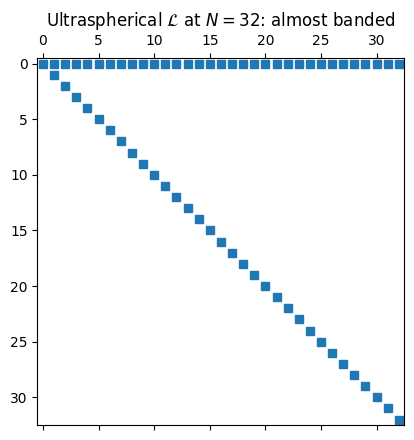
Multiplication operator for variable coefficients¶
For an equation with a variable coefficient like , we need one more piece: a multiplication operator that takes the -coefficients of and returns the -coefficients of . We build it in three steps using the Chebyshev recurrence.
The pointwise product of two Chebyshev expansions makes the coefficient space into a Banach algebra. The multiplication operator below is the matrix realisation of “multiply by ” in this algebra. For the analytic underpinnings see Banach Algebras (MATH 725).
Building block. Multiplication by in the basis. The identity (with ) gives the symmetric tridiagonal
Multiplication by . The Chebyshev recurrence lifts directly to operators:
Each application of widens the band by one, so has bandwidth exactly .
General . If , linearity gives
a banded matrix of bandwidth at most . A coefficient with a short Chebyshev expansion produces a narrow operator. The simplest case has and gives the tridiagonal .
The full operator. For ,
an almost-banded operator: dense top row from the boundary condition, banded interior of bandwidth . The construction extends to any number of dense rows (more boundary conditions) and any short-Chebyshev coefficients.
This is the operator we use in Adaptive QR: Choosing N on the Fly to drive the QR sweep on a genuinely variable-coefficient problem.
Preconditioning for direct solves¶
The ultraspherical operator is sparse, but it is not
yet well-scaled. The differentiation matrix has rows
growing linearly with the column index — entry ,
so the -th column of the interior is times bigger than the
first. A direct solve via linalg.solve works, but its forward error
inherits a condition number that scales with .
The fix is a diagonal right preconditioner (Olver & Townsend (2013), §4.1). For an order- operator, set
For the first-order problems of this section (): .
The recipe for a direct solve is two lines of bookkeeping.
Build by scaling the columns of .
Solve as usual, then recover .
Olver-Townsend prove for the Dirichlet problem independent of , so the preconditioned solve has the same cost but a bounded condition number. The same trick works for the streaming QR of Adaptive QR: Choosing N on the Fly: scale columns on the way in and rescale the recovered solution on the way out; the factorisation itself is unchanged.
from math import factorial

def column_scaling(n, nu):
    """Olver-Townsend right preconditioner for an order-nu ODE."""
    R = np.ones(n)
    if nu >= 2 and nu - 1 < n:
        R[nu - 1] = 1.0 / factorial(nu - 1)
    for k in range(nu, n):
        R[k] = 1.0 / k
    return R

# Condition number, with and without preconditioning, on the simplest
# first-order operator L = (b^T; D_0).
print(f"{'N':>5}  {'kappa(L)':>12}  {'kappa(L R)':>12}")
for N in [16, 32, 64, 128, 256, 512]:
    L = ultra_first_order(N)
    R = column_scaling(N + 1, nu=1)
    LR = L * R[None, :]                          # column scaling
    print(f"{N:5d}  {np.linalg.cond(L):12.2e}  {np.linalg.cond(LR):12.2e}")
N kappa(L) kappa(L R)
16 2.82e+01 3.28e+00
32 5.65e+01 3.31e+00
64 1.13e+02 3.33e+00
128 2.27e+02 3.34e+00
256 4.53e+02 3.34e+00
512 9.07e+02 3.34e+00
Without scaling, grows with . With scaling, the condition number is bounded by a small constant. That is what makes the ultraspherical method well-conditioned in the practical sense, not just sparse.
Physical-Space Collocation: an Alternative¶
The textbook alternative writes everything in the value basis at Chebyshev nodes. Let
be a linear two-point BVP, and let be the unknown values at the type-1 Chebyshev nodes. From §5, differentiation at the nodes is and , so the differential operator becomes the matrix
Demanding at the interior nodes and replacing the first and last rows with the boundary conditions gives a square linear system to solve.
That is all there is to it: one differentiation matrix, one diagonal multiplication for each coefficient, two row replacements for the boundary conditions.
Worked example¶
Solve on with homogeneous Dirichlet boundary conditions, manufacturing from .
def cheb_diff_matrix(N):
    x = np.cos(np.pi * np.arange(N+1) / N)
    c = np.ones(N+1); c[0] = 2; c[N] = 2; c[1::2] *= -1
    X = np.outer(x, np.ones(N+1)); dX = X - X.T + np.eye(N+1)
    D = np.outer(c, 1/c) / dX
    D -= np.diag(D.sum(axis=1))
    return D, x

def solve_bvp(a, b, c, f, alpha, beta, N):
    D, x = cheb_diff_matrix(N)
    L = np.diag(a(x)) @ D @ D + np.diag(b(x)) @ D + np.diag(c(x))
    rhs = f(x)
    L[0, :] = 0; L[0, 0] = 1; rhs[0] = beta
    L[N, :] = 0; L[N, N] = 1; rhs[N] = alpha
    return x, la.solve(L, rhs)

ue = lambda x: (1 - x**2) * np.exp(np.sin(5*x))
def rhs_f(x):
    s, c5 = np.sin(5*x), np.cos(5*x); E = np.exp(s)
    upp = -2*E - 20*x*c5*E + (1-x**2)*((25*c5**2 - 25*s)*E)
    return -upp + (1 + x**2)*ue(x)

a = lambda x: -np.ones_like(x)
b = lambda x:  np.zeros_like(x)
c = lambda x:  1 + x**2

xx = np.linspace(-1, 1, 600)
x16, u16 = solve_bvp(a, b, c, rhs_f, 0, 0, N=16)

fig, (axL, axR) = plt.subplots(1, 2, figsize=(11, 4.2))
axL.plot(xx, ue(xx), 'k', lw=2, label='exact')
axL.plot(x16, u16, 'o', ms=5, label='spectral, $N=16$')
axL.set_title('BVP solution'); axL.legend(); axL.set_xlabel('$x$')

Ns = np.arange(8, 81, 4)
err = []
for N in Ns:
    x, u = solve_bvp(a, b, c, rhs_f, 0, 0, N)
    err.append(np.max(np.abs(u - ue(x))))
axR.semilogy(Ns, err, 'o-')
axR.set_xlabel('$N$'); axR.set_ylabel(r'$\|u_N - u\|_\infty$')
axR.set_title('Spectral convergence')
plt.tight_layout(); plt.show()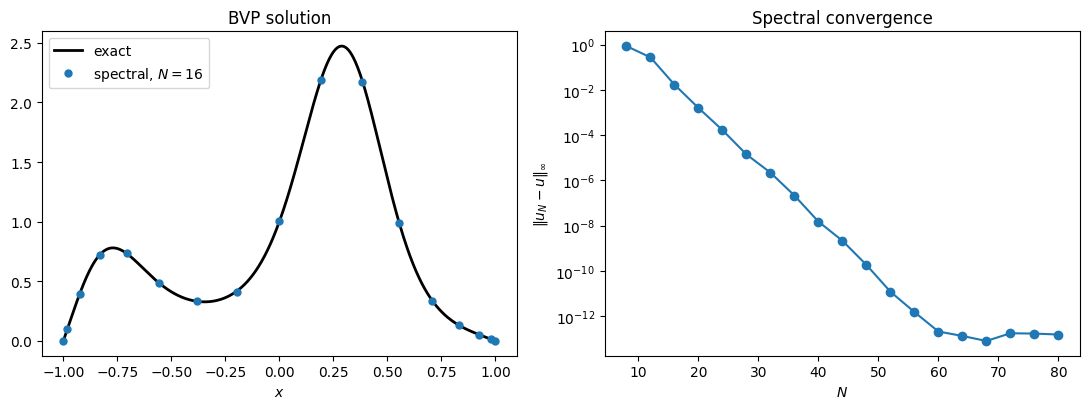
The error halves the digit count between and . This is geometric convergence, exactly the coefficient-decay result transported through the linear solve.
The conditioning problem¶
Geometric convergence is the prize. The cost is two-fold:
Density. is dense, so each solve costs instead of for a banded system.
Conditioning. From §5, . Backward stability of
solvethen bounds the achievable accuracy at . For high-order operators (think in beam equations) the exponent grows: . Pushing above a few hundred in double precision is hopeless.
The two costs are visible side by side: the dense physical-space next to the almost-banded ultraspherical .
N = 32
D_phys, _ = cheb_diff_matrix(N)
L_ultra = ultra_first_order(N)

fig, axes = plt.subplots(1, 2, figsize=(10, 4.5))
axes[0].spy(D_phys, markersize=3)
axes[0].set_title(f'Physical-space $D$: dense, $N = {N}$')
axes[1].spy(L_ultra, markersize=6)
axes[1].set_title(r'Ultraspherical $\mathcal{L}$: almost banded')
plt.tight_layout(); plt.show()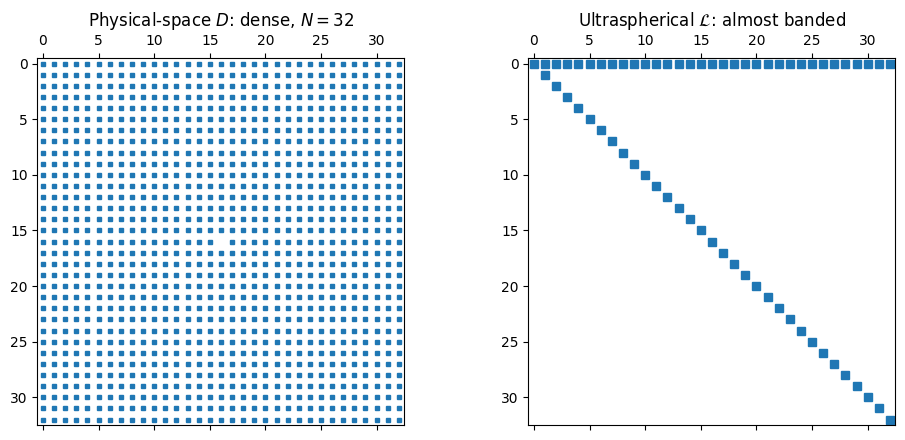
Physical-space collocation is the right tool when is moderate and the operator is well-conditioned. For stiff or high-order problems, or when has to grow large, the ultraspherical formulation pays off.
Higher-Order Operators¶
The construction above generalises cleanly to any order of derivative. A second derivative lives in , requiring a sparse differentiation map and a conversion . A multiplication operator acting on -coefficients is built by the same three-term recurrence as , with the appropriate Gegenbauer recurrence in place of the Chebyshev one. For an equation of order , the discretisation lives in and the resulting operator is again almost banded, with bandwidth determined by the differentiation order and the smoothness of the variable coefficients. The full theory, along with the analysis of conditioning and the optimal solver, is in Olver & Townsend (2013).
- Olver, S., & Townsend, A. (2013). A fast and well-conditioned spectral method. SIAM Review, 55(3), 462–489.